

Installing an electric vehicle charger at your Surrey property can look straightforward, but the maze of british regulations and compliance checks means many homeowners feel lost before the first cable is connected. With over 70 percent of new electric vehicle charging points now required to meet smart capability standards across the United Kingdom, understanding what compliance truly involves is more important than ever. Discover practical insights on legal requirements, safe installation practices, and which government incentives could help offset your upfront costs.
Table of Contents
- What EV Charger Compliance Means In Surrey
- Types Of EV Chargers And UK Standards
- OZEV Approval, NICEIC Certification And Installer Roles
- Planning Permission, Site Surveys And DNO Notification
- Legal And Financial Risks Of Non-Compliance
- Common Pitfalls To Avoid During Installation
Key Takeaways
| Point | Details |
|---|---|
| EV Charger Compliance | Ensures chargers meet UK technical standards, including smart features and grid management to support renewable energy. |
| Types of EV Chargers | Classified into slow, fast, and rapid categories, each with specific applications and power outputs tailored to various needs. |
| Installer Certification | OZEV and NICEIC certifications are vital for ensuring quality and safety in EV charger installations. |
| Compliance Risks | Non-compliance can lead to legal repercussions, financial penalties, and loss of warranties, highlighting the importance of adhering to regulations. |
What EV charger compliance means in Surrey
Electric vehicle (EV) charger compliance in Surrey represents a comprehensive set of technical, safety, and regulatory standards that ensure charging infrastructure meets national and local requirements. These regulations go beyond simple installation protocols, encompassing smart technology integration, grid management capabilities, and consumer protection mechanisms.
At its core, EV charger compliance involves adhering to UK government guidelines that mandate specific technical specifications for charging points. Smart charging regulations require chargers to have intelligent features enabling dynamic electricity demand management. This means Surrey’s EV chargers must be capable of responding to grid signals, potentially adjusting charging rates during peak and off-peak periods to support renewable energy integration and electrical network stability.
Local compliance also involves ensuring charging infrastructure meets Surrey County Council’s strategic objectives. This includes compatibility with multiple electric vehicle models, accessibility standards, and integration with national charging directories. Property owners and businesses must navigate these requirements carefully, considering factors such as:- Technical interoperability with various EV models- Safety certification standards- Smart technology capabilities- Grid demand management features- Accessibility and user experience considerationsPro tip: Before installing an EV charger, consult a certified local electrician who understands Surrey’s specific compliance landscape to ensure your charging point meets all regulatory requirements.
Types of EV chargers and UK standards
The United Kingdom has established comprehensive standards for electric vehicle (EV) chargers, categorising them into distinct types based on power output, connectivity, and installation requirements. Charging points are primarily classified into three main categories: slow, fast, and rapid charging solutions, each designed to meet different electric vehicle charging needs across residential, commercial, and public environments.
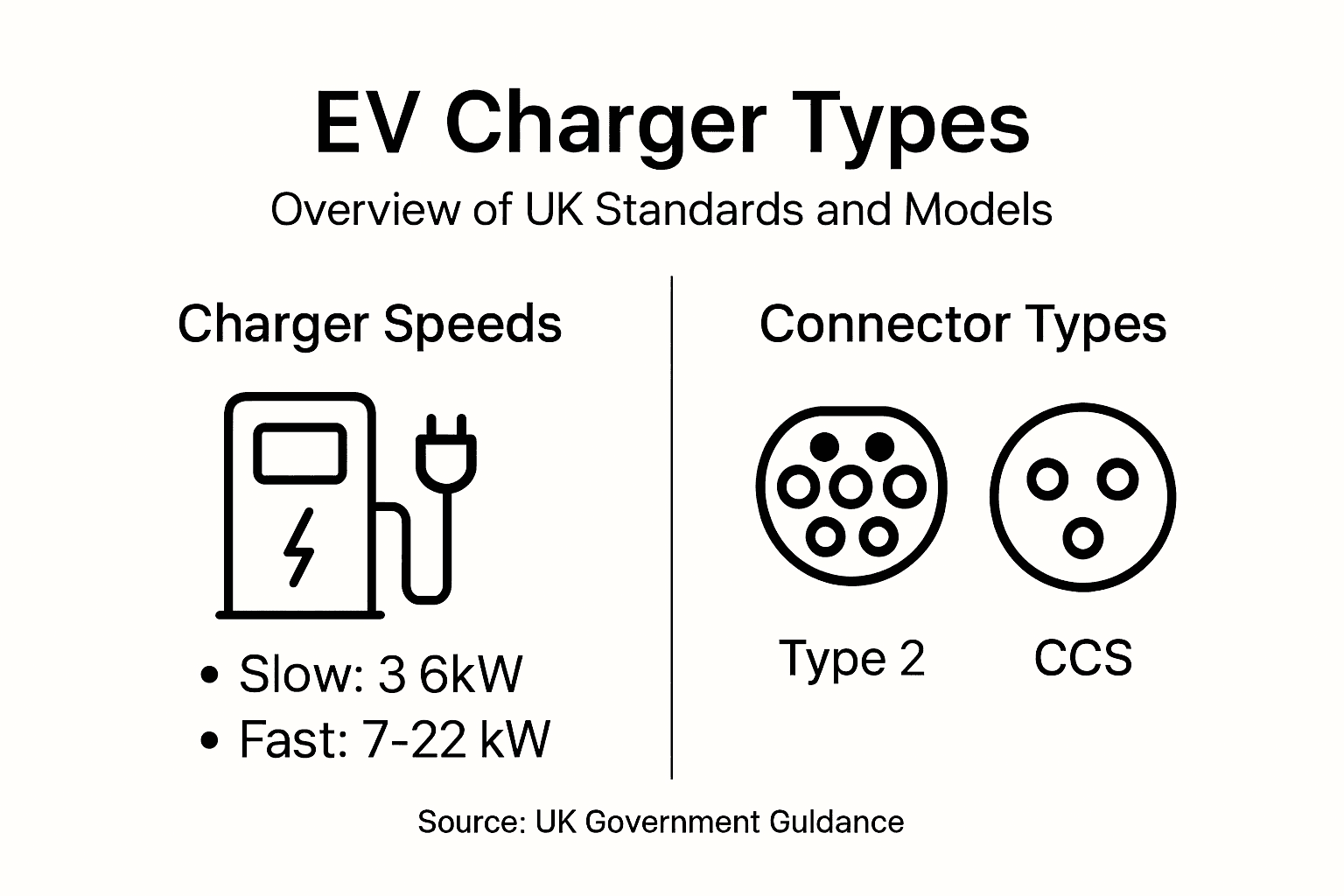
UK charging infrastructure specifications define precise technical requirements for these charger types. Residential chargers typically range from 3.6 kW to 7.4 kW, providing overnight charging capabilities, while commercial and public charging stations can deliver up to 22 kW using three-phase power. Rapid charging stations represent the most advanced category, offering 50 kW direct current (DC) charging that can replenish an electric vehicle’s battery to 80% capacity in approximately 30-40 minutes.
The technical standards also mandate specific connector types, with Type 2 (Mennekes) and Combined Charging System (CCS) being the most prevalent in the UK market. These standards ensure interoperability, safety, and consistent performance across different vehicle manufacturers and charging infrastructure providers. Key considerations for EV charger compliance include:- Electrical safety certification- Smart charging capabilities- Grid load management features- Standardised communication protocols- Compatibility with multiple vehicle models
Here is a comparison of EV charger types and their typical applications in the UK:
| Charger Type | Typical Power Output | Common Installation Site | Charging Time (to 80%) |
|---|---|---|---|
| Slow | 3.6–7.4 kW | Homes, small businesses | 6–12 hours |
| Fast | 7.4–22 kW | Workplaces, car parks | 2–4 hours |
| Rapid | 50 kW (DC) | Motorway services, public hubs | 30–40 minutes |
Pro tip: When selecting an EV charger, confirm its compatibility with your specific electric vehicle model and verify that it meets the latest UK technical standards for optimal performance and safety.
OZEV approval, NICEIC certification and installer roles
The landscape of electric vehicle (EV) charger installations in the United Kingdom is governed by rigorous certification processes designed to ensure safety, quality, and reliability. OZEV approval and NICEIC certification represent two critical benchmarks that validate both the equipment and the professionals responsible for EV charging infrastructure deployment.
UK public charge point regulations mandate that EV charger installers must be qualified electricians registered with accredited bodies. These professionals play a pivotal role in ensuring that charging infrastructure meets stringent national standards. The Office for Zero Emission Vehicles (OZEV) approval process specifically certifies that charging equipment complies with government safety, durability, and efficiency requirements, which is crucial for accessing government grant funding and maintaining high-quality electrical installations.

The NICEIC (National Inspection Council for Electrical Installation Contracting) certification represents the pinnacle of professional electrical competence. Certified installers are required to demonstrate comprehensive knowledge of electrical systems, wiring regulations, and specific technical requirements for EV charging points. Their responsibilities extend beyond simple installation and include:- Conducting thorough site assessments- Ensuring electrical system compatibility- Performing safety inspections- Obtaining necessary permissions- Implementing grid connection protocols- Verifying equipment specifications
This summary highlights key compliance bodies and their main responsibilities for EV charger installations:
| Compliance Body | Primary Role | Key Benefit for End User |
|---|---|---|
| OZEV | Equipment approval, grants | Ensures safety and grant access |
| NICEIC | Installer certification | Guarantees installation quality |
| DNO | Grid safety management | Maintains network stability |
Pro tip: Always request proof of OZEV and NICEIC certification from your electrical installer, and verify their credentials with the respective professional bodies before proceeding with any EV charger installation.
Planning permission, site surveys and DNO notification
Installing an electric vehicle (EV) charger involves navigating a complex landscape of regulatory requirements that extend beyond simple electrical work. Planning permissions and site surveys represent critical steps in ensuring a compliant and safe EV charging installation, particularly in residential and commercial settings across Surrey.
UK charge point installation regulations highlight the nuanced approach required for EV charger deployments. While most home installations do not mandate explicit planning permission, property owners must conduct comprehensive site surveys to assess electrical infrastructure compatibility, potential grid constraints, and installation feasibility. These assessments evaluate critical factors such as electrical system capacity, proximity to consumer units, available power supply, and potential infrastructure modifications.
The Distribution Network Operator (DNO) notification process is a crucial compliance mechanism that ensures electrical grid safety and stability. Installers must provide detailed information about the proposed charging point, including electrical load requirements, connection specifications, and potential impact on local network infrastructure. Key considerations during the DNO notification process include:- Electrical load assessment- Grid connection protocols- Potential network upgrades- Safety compliance verification- Technical specification review- Impact on local electrical infrastructure
Pro tip: Engage a certified electrical installer who can manage the entire DNO notification process and conduct thorough site surveys, ensuring seamless EV charger installation and regulatory compliance.
Legal and financial risks of non-compliance
The landscape of electric vehicle (EV) charger installations is fraught with significant legal and financial consequences for those who fail to adhere to stringent regulatory standards. Non-compliance is not merely a bureaucratic technicality but a serious risk that can result in substantial financial penalties and potential legal repercussions for property owners and installers alike.
Electric vehicle charging regulations underscore the comprehensive nature of potential risks associated with improper EV charger installations. Financial exposures extend beyond immediate fines, potentially including voided equipment warranties, ineligibility for government incentive schemes, and increased insurance liabilities. Businesses and homeowners could face unexpected costs from mandatory retrofitting, potential electrical system remediation, and legal proceedings arising from safety breaches.
The spectrum of non-compliance risks encompasses multiple critical domains, including:- Regulatory fines from government agencies- Invalidation of electrical installation warranties- Loss of eligibility for green energy grants- Potential liability for electrical safety incidents- Increased insurance premium costs- Reputational damage to businesses and property owners- Mandatory system upgrades and retrospective modifications- Legal challenges from regulatory bodies
Pro tip: Engage a certified EV charging installation professional who understands the full regulatory landscape and can provide comprehensive compliance documentation to mitigate potential legal and financial risks.
Common pitfalls to avoid during installation
Electric vehicle (EV) charger installation requires meticulous attention to detail and comprehensive understanding of technical and regulatory requirements. Electrical infrastructure compatibility represents one of the most critical considerations, with potential complications arising from seemingly minor oversights that can compromise safety and performance.
Home EV charger installation requirements reveal multiple critical pitfalls that property owners and installers must carefully navigate. Improper electrical load assessment stands as a primary risk, potentially leading to system overload, circuit breaker tripping, or even dangerous electrical configurations. Installers must comprehensively evaluate existing electrical infrastructure, including consumer unit capacity, available circuit capabilities, and potential need for system upgrades before commencing installation.
The most prevalent installation pitfalls encompass several key areas:- Inadequate electrical load capacity verification- Using non-OZEV approved equipment- Poor cable management techniques- Skipping mandatory safety inspections- Neglecting DNO notification requirements- Insufficient earthing and protection mechanisms- Improper mounting and positioning of charging units- Overlooking specific wiring regulation compliance
Pro tip: Request a comprehensive site survey from a certified electrical professional who can identify potential infrastructure challenges and ensure your EV charger installation meets all technical and regulatory standards before proceeding.
Ensure Your EV Charger Meets Surrey Compliance Standards with Expert Installation
Navigating the complex requirements of EV charger compliance in Surrey can be daunting. From OZEV approval and NICEIC certification to DNO notifications and smart charging regulations, missing a single step could expose you to legal and financial risks. Property owners and businesses need a trusted partner who understands these challenges and can deliver compliant, safe, and efficient installations tailored to your specific site needs.
Choose ADS Electrics for professional EV charger installation in Surrey. Our certified electricians provide comprehensive services including detailed site surveys, full regulatory compliance checks, and assistance with government grants. Don’t risk fines or unsafe installations. Act now to secure your reliable, future-proof EV charging solution with fast turnaround times and expert support. Visit our EV Charger Installation Redhill Surrey page to get started and ensure your EV charger meets all UK standards today.
Frequently Asked Questions
What does EV charger compliance mean?
EV charger compliance refers to a set of technical, safety, and regulatory standards that charging infrastructure must meet to ensure safety, interoperability, and functionality, aligning with both national and local guidelines.
Why is it important to ensure EV charger compliance before installation?
Ensuring EV charger compliance is crucial to meet safety regulations, avoid legal and financial risks, and ensure efficient operation of the charging infrastructure, ultimately protecting users and the electrical network.
What types of EV chargers are available, and what are their typical applications?
EV chargers are categorised into three main types: slow (3.6–7.4 kW), fast (7.4–22 kW), and rapid (50 kW). Slow chargers are typically used at homes, fast chargers at workplaces, and rapid chargers at public hubs and motorway services.
What certifications should EV charger installers possess?
EV charger installers should possess OZEV approval and NICEIC certification to ensure safety, compliance with government standards, and the quality of the installation process.
Recommended
- EV Charger Installation Surrey – The Complete Electrical Service
- EV Charger Installation Company In Surrey – ADS Electrical – The Complete Electrical Service
- #1 Electric Vehicle Charger Installation Company Near Me Kingswood Surrey – The Complete Electrical Service
- Professional EV Charger Installation In Nutfield Surrey – %ADS Electrical%