

Nearly one in three British homes with electric vehicles now relies on dedicated EV chargers for daily convenience. As electric cars become the norm across Surrey, more homeowners are weighing the benefits of installing a charger at home instead of depending on public stations. This article breaks down common myths, upfront costs, government grants, and the real value these installations add, helping Surrey homeowners make informed decisions aligned with British sustainability goals.
Table of Contents
- Defining Home EV Chargers And Common Myths
- Types Of Home EV Chargers Explained
- How Home Charging Works Efficiently
- UK Government Grants And Legal Standards
- Financial Impact: Costs And Saving Analysis
- Added Value: Convenience And Property Benefits
Key Takeaways
| Point | Details |
|---|---|
| Home EV Chargers are Essential | Home EV chargers offer significant convenience and cost efficiency over public charging, acting as practical necessities for regular users. |
| Types of Chargers | Level 2 chargers are recommended for most homeowners due to their faster charging capabilities, ensuring vehicles can be fully charged overnight. |
| Financial Savings | The initial investment in home charging infrastructure can lead to significant long-term savings on fuel and maintenance costs, with potential recovery within a few years. |
| Property Value Increase | Having a home EV charger can enhance property desirability and resale value as eco-conscious buyers seek homes with electric vehicle infrastructure. |
Defining Home EV Chargers And Common Myths
Home electric vehicle (EV) chargers represent sophisticated charging solutions designed specifically for residential environments, enabling vehicle owners to conveniently recharge their electric vehicles directly from their property. These specialised devices, typically Level 2 charging units, operate using 240-volt electrical systems and provide substantially faster charging capabilities compared to standard household outlets.
Contrary to popular misconceptions, home EV chargers are not luxury additions but practical necessities for regular electric vehicle users. Most EV owners discover that home charging is significantly more convenient and cost-effective than relying exclusively on public charging infrastructure. The ability to charge overnight means vehicles are consistently ready for daily use, with many units capable of delivering approximately 25 miles of range per hour of charging – a critical convenience for busy professionals and families.
Several persistent myths surround home EV charging that require clarification. Many individuals mistakenly believe that standard 120-volt household outlets are sufficient for daily charging needs. However, global charging data demonstrates that dedicated home chargers are overwhelmingly preferred, with private charging points outnumbering public stations by nearly ten to one worldwide. These dedicated units offer faster charging speeds, greater reliability, and more consistent performance compared to basic electrical outlets.
Pro tip:Before installing a home EV charger, consult a certified electrician to assess your property’s electrical capacity and determine the most suitable charging solution for your specific vehicle model and household infrastructure.
Types Of Home EV Chargers Explained
Electric vehicle charging systems are categorised into distinct levels that determine charging speed, power requirements, and practical usability for residential environments. Home EV charging technologies primarily fall into three fundamental categories: Level 1, Level 2, and Level 3, each offering unique capabilities and suited to different household needs and vehicle requirements.
Level 1 chargers represent the most basic charging option, utilising standard 120-volt household electrical outlets. These chargers provide a modest charging rate of approximately 3.5 to 6.5 miles of range per hour, making them suitable for drivers with minimal daily mileage or those who can leave their vehicle plugged in for extended periods. While convenient due to their universal compatibility, Level 1 chargers are significantly slower compared to more advanced alternatives and may struggle to meet the charging demands of frequent drivers.
Level 2 chargers emerge as the preferred solution for most residential electric vehicle owners, offering substantially enhanced charging performance. Charging equipment operating at 240 volts delivers between 14 to 35 miles of range per hour, enabling most vehicles to achieve a full charge overnight. These systems require professional installation of a dedicated electrical circuit, typically involving modifications to the home’s electrical infrastructure. The investment in a Level 2 charger provides considerable advantages in terms of charging speed, reliability, and overall convenience for daily electric vehicle usage.
Pro tip:Consult a certified electrician specialising in EV charging installations to assess your home’s electrical capacity and recommend the most appropriate charging solution for your specific vehicle model and household requirements.
Here’s how the three main home EV charger types compare:
| Charger Type | Power Supply | Typical Charge Speed | Best For |
|---|---|---|---|
| Level 1 | 120 volts | 3.5–6.5 miles/hour | Light daily use |
| Level 2 | 240 volts | 14–35 miles/hour | Regular daily drivers |
| Level 3 | 400+ volts | 60–250 miles/hour | Rapid, but rare in homes |
How Home Charging Works Efficiently
Home electric vehicle charging represents a sophisticated process that balances technological efficiency with practical energy management. Global electric vehicle charging trends demonstrate that most EV owners prefer overnight charging at home, strategically leveraging off-peak electricity rates and minimising grid strain while maximising cost-effectiveness.

The core of efficient home charging relies on sophisticated smart charging technologies that optimise electricity consumption and battery performance. Modern home charging systems integrate intelligent load management features, allowing electric vehicles to draw power during low-demand periods. This approach not only reduces electricity costs but also contributes to broader electrical grid stability. Charging strategies for home EV owners typically involve using Level 2 chargers connected to 240-volt circuits, enabling complete vehicle recharging within 4 to 10 hours – an ideal timeframe for overnight charging.
Advanced home charging setups incorporate multiple efficiency-enhancing features. These include programmable charging schedules, real-time energy consumption monitoring, and adaptive charging algorithms that respond to household electricity demand and current battery status. By integrating these intelligent systems, electric vehicle owners can significantly reduce charging expenses while maintaining optimal battery health and minimising environmental impact.
Pro tip:Install a smart electricity metre alongside your EV charger to track and optimise your home charging costs and energy consumption in real-time.
UK Government Grants And Legal Standards
The United Kingdom has established comprehensive regulatory frameworks and financial incentives to support the widespread adoption of electric vehicle infrastructure. EV charger installation regulations mandate strict electrical safety standards, ensuring that home charging systems meet rigorous performance and protection requirements.
Key legislative requirements include the BS 7671 wiring regulations, which provide detailed guidance for electrical installations. These standards specifically address EV charging infrastructure, requiring dedicated electrical circuits, robust protective mechanisms, and meticulous adherence to manufacturer installation instructions. Homeowners must ensure their electrical setup complies with these regulations, which are designed to prevent electrical hazards and guarantee optimal charging performance.
The Electric Vehicle Homecharge Scheme (EVHS) represents a significant government initiative to encourage electric vehicle adoption. This programme offers financial support to eligible homeowners, effectively reducing the upfront costs associated with home EV charger installations. By providing grants that offset installation expenses, the UK government aims to accelerate the transition to electric mobility, making sustainable transportation more accessible to a broader range of households.
Pro tip:Consult a certified electrician who understands current BS 7671 regulations to ensure your EV charger installation meets all legal and safety requirements.
Financial Impact: Costs And Saving Analysis
Home electric vehicle charging represents a strategic financial investment with significant long-term economic benefits. Global charging economics demonstrate that residential charging can substantially reduce overall transportation expenses by leveraging more affordable electricity rates compared to traditional fuel purchases.
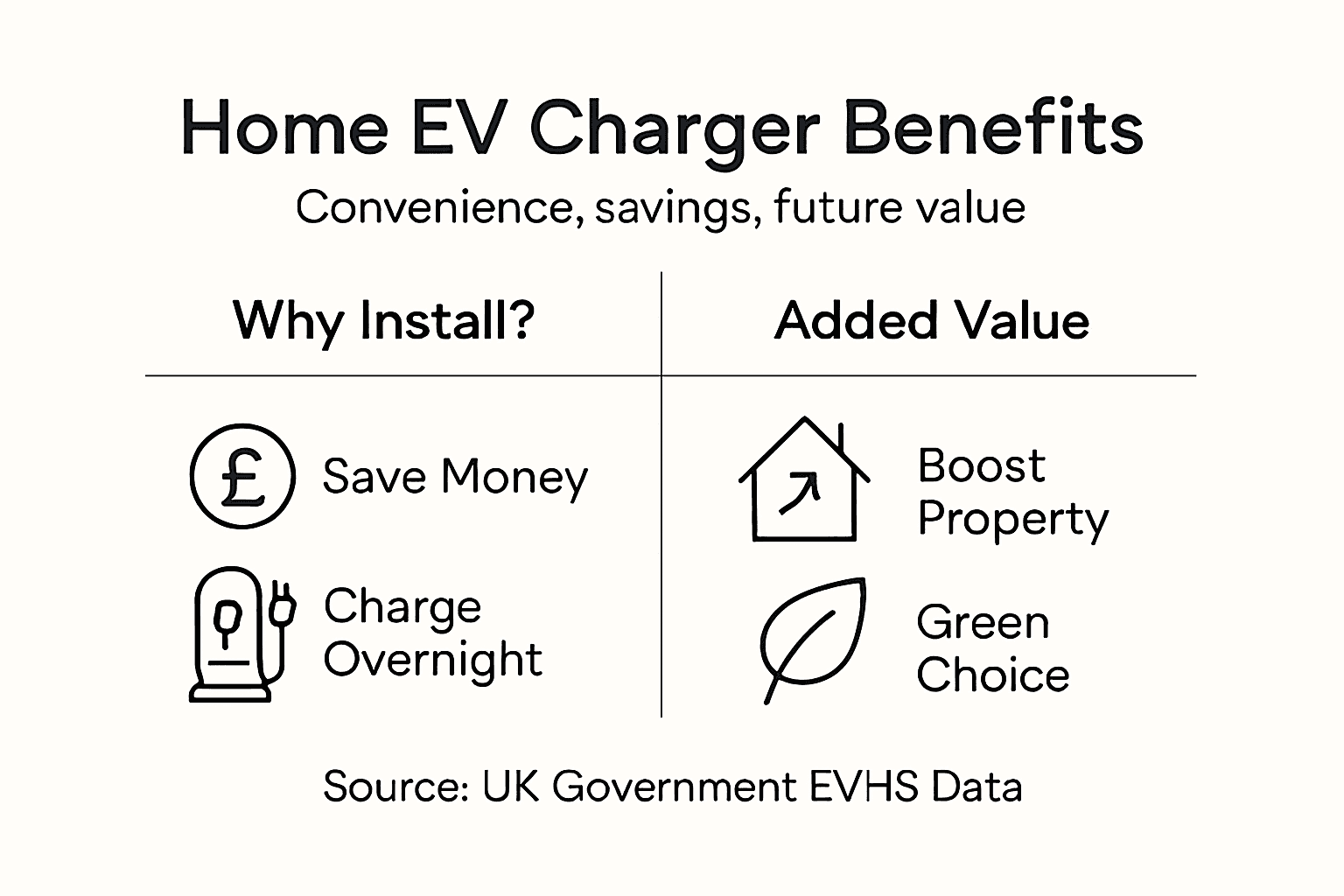
Typical home EV charger installations involve initial costs ranging between £1,000 and £3,000, depending on electrical infrastructure requirements and specific charging unit specifications. These upfront expenses can be mitigated through government incentive programmes and potential energy savings. Home EV charger installation costs reveal that strategic planning can offset initial investments through reduced charging expenses, with many homeowners experiencing complete cost recovery within three to five years of installation.
The economic advantages extend beyond immediate charging costs. Electric vehicle owners benefit from lower maintenance expenses, reduced fuel expenditures, and potential tax incentives. By charging during off-peak electricity hours, households can further minimise energy costs, transforming their home charging setup into a financially prudent long-term strategy. The cumulative savings potentially represent thousands of pounds over the vehicle’s operational lifecycle, making home EV charging an increasingly attractive financial proposition.
Below is a summary of key financial advantages for home EV charging:
| Financial Factor | Impact on Owner | Typical Result |
|---|---|---|
| Upfront Installation | One-off investment | £1,000–£3,000 initial cost |
| Ongoing Running Cost | Lower than fuel petrol | Significantly reduced bills |
| Maintenance Savings | Fewer moving parts | Lower annual service expenses |
| Property Value | Improves house appeal | Potential higher resale value |
Pro tip:Calculate your potential annual savings by comparing current fuel expenses with projected home electricity charging costs to understand your precise financial benefits.
Added Value: Convenience And Property Benefits
Home electric vehicle chargers represent far more than a mere technological upgrade, offering transformative benefits that extend well beyond simple vehicle charging. Home charging convenience factors demonstrate how these installations dramatically simplify daily transportation logistics, eliminating the stress of finding public charging stations and ensuring vehicles are consistently ready for immediate use.
The property value implications of home EV charger installations are particularly significant in today’s evolving real estate market. Eco-conscious homebuyers increasingly view pre-installed charging infrastructure as a premium feature, effectively positioning properties with these amenities as more desirable and forward-thinking. Global electric vehicle infrastructure trends indicate that homes equipped with dedicated charging capabilities can potentially command higher resale values, reflecting the growing mainstream adoption of electric vehicles.
Beyond immediate convenience, home EV chargers contribute to broader sustainability efforts by reducing strain on public charging networks and supporting more efficient energy management. The ability to charge during off-peak electricity hours not only reduces individual energy costs but also supports local electrical grid stability. This multipronged benefit showcases how home charging transcends personal convenience, representing a meaningful contribution to broader environmental and infrastructural objectives.
Pro tip:Document your home EV charger installation with professional certification and energy efficiency ratings to maximise potential property value increases.
Discover Seamless Home EV Charging Solutions in Surrey
The article highlights key challenges such as the need for reliable, fast home charging that fits busy lifestyles without compromising safety or increasing costs unnecessarily. For EV owners seeking convenience, efficient savings, and compliance with UK electrical standards, professional installation is essential. Home chargers that offer Level 2 charging, supported by smart technology, can transform daily routines while reducing running costs and adding property value.
At The Complete Electrical Service, we fully understand these demands and provide expert electric vehicle charger installations tailored to Surrey residents. Our team is OZEV approved and NICEIC certified, ensuring installations meet the stringent BS 7671 regulations discussed in the article. Whether you want guidance on government grants or need a comprehensive site survey, we handle every detail quickly and professionally.
Take the next step towards effortless EV charging by visiting our dedicated Surrey installation page Electric Vehicle Charger Installation in Redhill, Surrey today. Let us help you enjoy the benefits of home charging with confidence and expert support.
Ready to upgrade your home charging experience with certified professionals ensuring compliance and quality?
Contact us now at Electric Vehicle Charger Installation in Redhill, Surrey to schedule your free consultation and secure your government grant before it expires.
Frequently Asked Questions
What are the benefits of installing a home EV charger?
Installing a home EV charger offers significant benefits, including convenience by eliminating the need to find public charging stations, cost savings on electricity compared to petrol, and potential increases in property value due to eco-friendly features.
How does charging at home save money compared to using public chargers?
Home charging typically leverages off-peak electricity rates, which can be significantly cheaper than public charging costs. Additionally, owning a home charger reduces reliance on more expensive petrol or public charging fees, resulting in substantial long-term savings.
What is the difference between Level 1 and Level 2 EV chargers?
Level 1 chargers use standard 120-volt outlets and provide a slower charging rate of 3.5 to 6.5 miles of range per hour, suitable for light users. Level 2 chargers operate on 240 volts, offering much faster charging at 14 to 35 miles of range per hour, ideal for regular drivers needing quicker turnaround times.
Do I need a professional to install my home EV charger?
Yes, it is recommended to consult a certified electrician for the installation of a home EV charger. A professional will ensure that your electrical system complies with safety regulations and that the charger is installed correctly for optimal performance.
Recommended
- #1 EV Charger Installation Company In Hailsham, East Sussex – The Complete Electrical Service
- #1 EV Charger Installation Company In Eastbourne, East Sussex – The Complete Electrical Service
- #1 EV Charger Installation Company In Heathfield, East Sussex – The Complete Electrical Service
- #1 EV Charger Installation Company In Herstmonceux, East Sussex – The Complete Electrical Service