

For Surrey homeowners making the switch to an electric vehicle, home charging is one of the most important decisions to get right. A suitable charger can make everyday driving more convenient, reduce reliance on public charging networks and help you take advantage of cheaper electricity or solar power.
The myenergi zappi is one of the best-known eco-smart EV chargers available in the UK. It is designed to charge from the electricity grid, solar generation or a combination of both. But is Zappi eco-smart EV charging worth the investment for homes in Redhill and across Surrey?
In many cases, yes: but the best choice depends on your home, parking arrangement, energy tariff, solar system and typical driving habits.
What is a Zappi eco-smart EV charger?
Zappi is a smart home EV charger manufactured by myenergi. Unlike a basic charge point, it can monitor energy flowing around your home and adjust charging to suit your priorities.
The current Zappi range offers three main charging modes:
- FAST: Charges your vehicle using grid electricity at the maximum available rate.
- ECO: Uses available renewable energy where possible, supplementing it with grid electricity when necessary.
- ECO+: Prioritises surplus renewable energy and can pause charging when there is not enough surplus available.
The charger uses current sensors, commonly referred to as CT clamps, to monitor electricity import, export and household demand. This allows it to identify when excess solar power is available and divert that energy into your vehicle rather than exporting it to the grid.
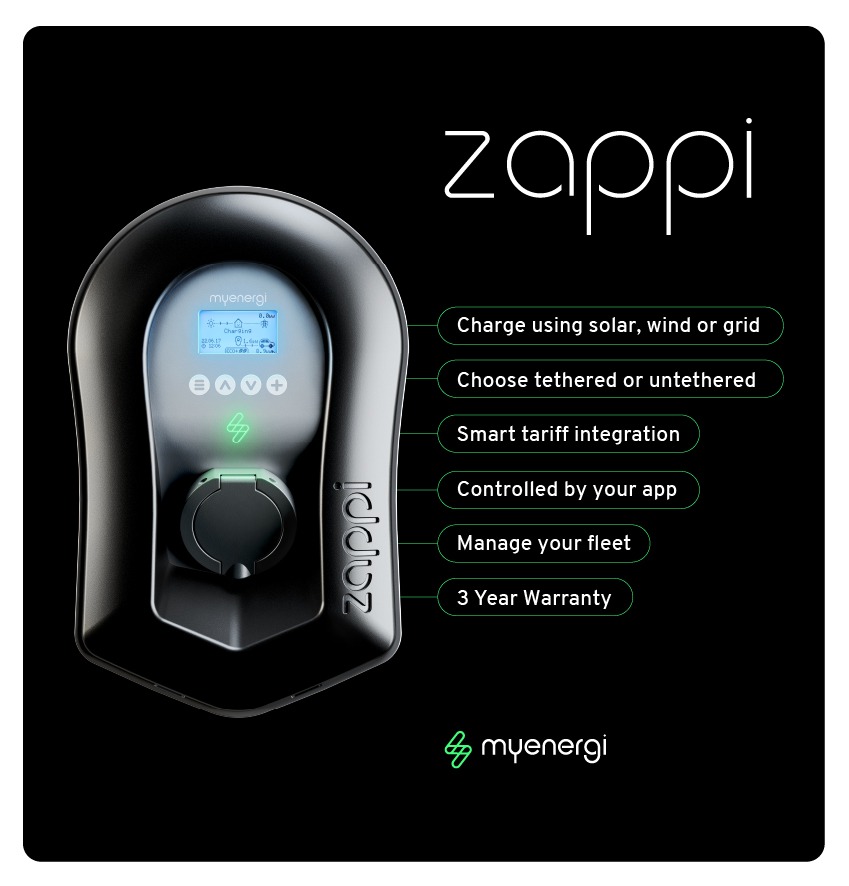
According to the official Zappi product information, the charger is available in domestic 7kW single-phase versions and 22kW three-phase versions. The 7kW model is generally the relevant option for most houses in Redhill and Surrey.
Why Zappi can suit Surrey homes
1. It can work with solar panels
Surrey has many properties with rooftop solar panels, particularly homes with suitable south-, east- or west-facing roofs. If you already have solar PV, a Zappi can help you use more of the electricity you generate yourself.
Without a smart charger, excess solar electricity may be exported to the grid when your car is not charging. With Zappi ECO or ECO+ modes, surplus generation can instead be directed towards your EV.
This can be particularly useful if:
- You work from home and your vehicle is parked during the day.
- You regularly charge after returning from a short journey.
- Your solar system produces more electricity than your household uses.
- You want to increase self-consumption from your renewable energy system.
Solar output will naturally vary. A cloudy Surrey day may produce less energy than a bright summer afternoon, and winter generation is usually lower. ECO+ charging may therefore be slower or pause regularly when there is insufficient surplus. That is not a fault: it is the charger responding to real-time conditions.
2. It can support cheaper energy tariffs
A Zappi is not limited to solar charging. In FAST mode, it works like a conventional home charger. Through its smart controls and app, you can also schedule charging for periods when your electricity tariff is cheaper.
For many EV drivers, the most economical routine is a combination of:
- Solar charging when surplus generation is available.
- Overnight charging on a low-cost time-of-use tariff.
- FAST charging before an urgent journey.
- Scheduled charging to avoid peak electricity periods.
The most suitable approach depends on your energy supplier and tariff. A smart charger cannot make an expensive tariff cheap by itself, so it is worth reviewing your electricity plan as part of the installation decision.

3. It makes home charging more convenient
For most EV owners, charging at home is easier than relying on public charge points. You can plug in after arriving home and schedule the vehicle to be ready for the following morning.
This can be especially helpful for residents in Redhill, Reigate, Merstham, Nutfield, Earlswood and surrounding areas who use their car for commuting, school runs or regular journeys across Surrey and into London.
A typical 7kW home charger can add a substantial amount of range overnight, although the exact result depends on the vehicle’s battery size, state of charge and onboard charging capability.
What are the potential drawbacks?
A Zappi is a capable product, but it is not automatically the right answer for every property.
Solar savings depend on your home
If you do not have solar panels, you can still use a Zappi with grid electricity and smart charging schedules. However, one of its key advantages: automatically using surplus renewable energy: will not be relevant until solar generation is installed.
Even with solar, the financial benefit depends on your energy use. If you are away from home during daylight hours, you may not be able to use much of your solar generation unless you have a home battery, workplace charging flexibility or a vehicle that remains parked during the day.
Installation can be more involved than expected
The physical charger is only one part of a safe EV charging installation. A qualified electrician needs to assess:
- The position of your consumer unit.
- The available electrical capacity.
- The condition of existing wiring.
- The proposed cable route to the driveway or garage.
- Whether additional protection is required.
- The location of the CT clamp and Wi-Fi signal.
- Whether notification to the local electricity network operator is needed.
Older Surrey homes may have long cable routes, detached garages, outbuildings, shared driveways or consumer units that need upgrading before a charger can be installed. Listed buildings and properties in conservation areas may also require additional planning checks.
A professional survey should identify these issues before work begins, rather than adding unexpected changes halfway through the installation.
The charger may cost more than a basic alternative
The official Zappi product page lists the charger from £779 including VAT at the time of writing, before installation and any additional electrical work. The total cost will depend on the cable distance, mounting surface, protective equipment, consumer unit requirements and whether groundworks are needed.
A cheaper basic charger may be sufficient if you simply want reliable overnight charging. Zappi becomes more compelling if you value solar integration, tariff scheduling, app control and future energy management.
Is Zappi suitable for a typical Redhill property?
For many domestic installations, the 7kW single-phase Zappi is the practical choice. Most UK homes have a single-phase electricity supply, and many EVs are designed to accept around 7kW AC charging at home.
The 22kW model is different. It normally requires a three-phase supply, and the vehicle must also support 22kW AC charging. Three-phase power is more common in commercial premises and some larger properties, but it should never be assumed to be available.
Properties with shared parking, flats or no private driveway may need additional planning. You may require consent from a freeholder, landlord, management company or local authority. If the charging cable would cross a public pavement, that also needs careful consideration; trailing cables can create a trip hazard and may not be an acceptable long-term solution.
For current grant eligibility, consult the GOV.UK electric vehicle chargepoint grant guidance. Schemes, approved equipment lists and installer requirements can change, so do not rely on an old grant advertisement when calculating your budget.
Zappi versus a basic home charger
A basic 7kW charger may be enough if your priorities are straightforward:
- Charge overnight.
- Use a standard electricity tariff.
- Do not have solar panels.
- Do not need detailed energy monitoring.
- Want to keep the initial purchase price as low as possible.
Zappi is more suitable when you want to manage energy intelligently. Its advantages are strongest when your home includes solar PV, a battery, a time-of-use tariff or several significant electrical loads.
The important point is that “smart” does not always mean “cheapest”. The charger, tariff, vehicle and household energy habits all work together. A good installer should discuss how you expect to charge rather than simply recommend the most feature-rich product.
Choosing an EV charger installer in Surrey
The installation quality is at least as important as the charger brand. Look for an experienced electrical contractor that can assess the complete installation, explain the options clearly and provide the correct certification when the work is complete.
ADS Electrical is an NICEIC Approved Contractor serving Redhill and surrounding Surrey areas. Our team provides domestic, commercial and industrial electrical services, including EV charging installation, consumer unit upgrades and fault finding.
We can help with:
- Charger position and cable-route planning.
- Assessment of the existing consumer unit.
- EV-rated protection and compliant installation.
- Solar-compatible charging requirements.
- Coordination with other trades or building work.
- Clear communication from quotation through to completion.
For a professional assessment, contact ADS Electrical for EV charger installation Redhill. We aim to provide free quotations within 24 hours, subject to receiving the information needed to assess your project.
Final verdict: is Zappi worth it for Surrey homes?
Zappi is worth considering if you want more than a simple plug-in-and-charge solution. Its solar-surplus modes, smart scheduling and integration with a wider home energy system make it particularly attractive to Surrey households with solar panels or flexible electricity tariffs.
It may be less worthwhile if you do not have renewable generation, rarely use your car or only need basic overnight charging. In those circumstances, a simpler charger could meet your needs at a lower initial cost.
The best decision starts with a property assessment. Consider your parking, consumer unit, solar generation, driving routine and future plans before choosing a charger. With the right design and a compliant installation, a Zappi can provide convenient, flexible and more energy-conscious EV charging for years to come.
Frequently asked questions
Can Zappi charge an EV without solar panels?
Yes. Zappi can charge from the electricity grid in FAST mode and can be scheduled around cheaper tariff periods. Solar panels are needed only if you want to use surplus solar charging.
Does Zappi need a separate solar inverter?
No. Zappi uses energy monitoring sensors to detect electricity flowing through the property. Your installer will need to understand the existing solar and electrical setup so the system can be configured correctly.
Is 7kW enough for a home in Surrey?
For most houses and EVs, 7kW is suitable for overnight charging. A 22kW charger requires compatible three-phase electrical infrastructure and a vehicle that can accept that charging rate.
Can an electrician install a Zappi?
A Zappi should be installed by a suitably qualified and competent electrician familiar with EV charging requirements. Ask for details of the proposed protection, certification and any network notification before work starts.
Can I install a Zappi on a shared driveway?
Possibly, but you may need permission from the property owner, freeholder or management company. Cable routing, parking rights and safe access must all be considered before installation.